The magnificent imperial garden retreat where architecture, landscape, and water combine in perfect harmony.
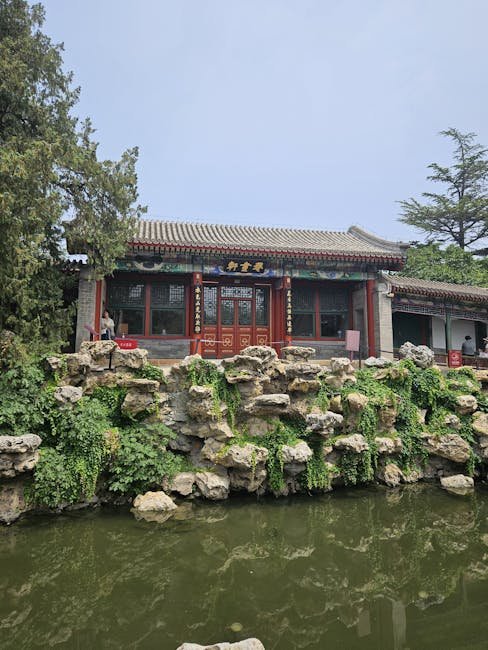
The Summer Palace (颐和园, Yi He Yuan), located about 15 kilometers northwest of central Beijing, is China's largest and most complete imperial garden complex. Originally built in 1750 during the reign of Emperor Qianlong of the Qing dynasty, the Summer Palace served as a summer retreat for the imperial court, providing a cool and beautiful escape from the heat and formality of the Forbidden City. The complex covers 290 hectares, with Kunming Lake occupying about three-quarters of the total area and Longevity Hill forming the northern backdrop.
Historical Background
The site of the Summer Palace has a long history as an imperial garden, dating back to the Jin dynasty (1115-1234). However, the current complex was largely created by Emperor Qianlong, who ordered the excavation of Kunming Lake and the construction of the main palaces and pavilions as a gift for his mother's sixtieth birthday. The resulting garden, known as the "Garden of Clear Ripples" (清漪园, Qing Yi Yuan), was one of the most magnificent imperial gardens ever created, combining natural landscape with architectural elements on a monumental scale.
The Summer Palace was severely damaged in 1860 during the Second Opium War, when British and French forces destroyed the nearby Old Summer Palace (Yuanmingyuan). It was rebuilt in 1886-1895 by Empress Dowager Cixi, who diverted funds intended for the modernization of the Chinese navy to restore and expand the Summer Palace as her personal retreat. This controversial history adds a layer of poignancy to the palace's beauty, as it represents both the artistic achievement and the political decline of the late Qing dynasty.
"The Summer Palace is the supreme achievement of Chinese imperial garden design. At no other site does architecture integrate so seamlessly with landscape on such a grand scale. The view from the top of Longevity Hill, with Kunming Lake spreading below and the Western Hills in the distance, is one of the great vistas of Chinese architecture."
Architectural Highlights
The Summer Palace contains numerous architectural masterpieces. The Long Corridor (长廊, Chang Lang) is the most famous — a covered walkway 728 meters long, decorated with over 14,000 painted panels depicting scenes from Chinese literature, mythology, and landscape. The corridor connects the main buildings along the lakeshore, providing a shaded, decorated passage that frames views of the lake and hills. The painted panels are a gallery of Chinese painting tradition, with each panel unique.
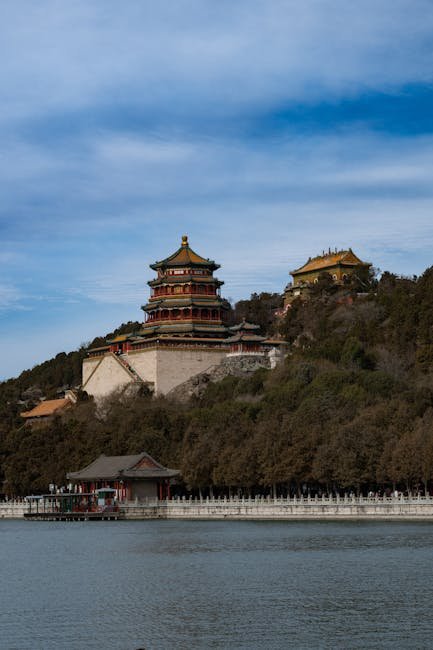
Longevity Hill (万寿山, Wan Shou Shan) is crowned by the Tower of Buddhist Incense (佛香阁, Fo Xiang Ge), a magnificent multi-story pavilion that is the visual centerpiece of the entire complex. The tower stands 41 meters tall on a 20-meter stone base, commanding views across the lake to the distant hills. Below the tower, a series of terraces descends the hillside, each level containing halls and pavilions that grow more ornate as the elevation increases. This vertical sequence from lake shore to hilltop is one of the most dramatic compositions in Chinese architecture.
Kunming Lake
Kunming Lake (昆明湖, Kunming Hu) is the centerpiece of the Summer Palace, covering 220 hectares. The lake was created by excavating earth that was used to build Longevity Hill, creating a classic Chinese garden feature — a large body of water with a hill rising behind it, symbolizing the Daoist paradise islands in the eastern sea. The lake is crossed by the Seventeen-Arch Bridge (十七孔桥, Shi Qi Kong Qiao), which connects the eastern shore to Nanhu Island. The bridge is 150 meters long, with its seventeen arches creating a graceful arc that reflects in the water below.
The Summer Palace was inscribed as a UNESCO World Heritage site in 1998, recognized as "a masterpiece of Chinese landscape garden design" that "integrates the natural landscape of hills and open water with manmade features such as pavilions, halls, palaces, temples, and bridges to form a harmonious ensemble of outstanding aesthetic value." It remains one of the most popular tourist destinations in China, attracting millions of visitors who come to experience the beauty of imperial garden design.