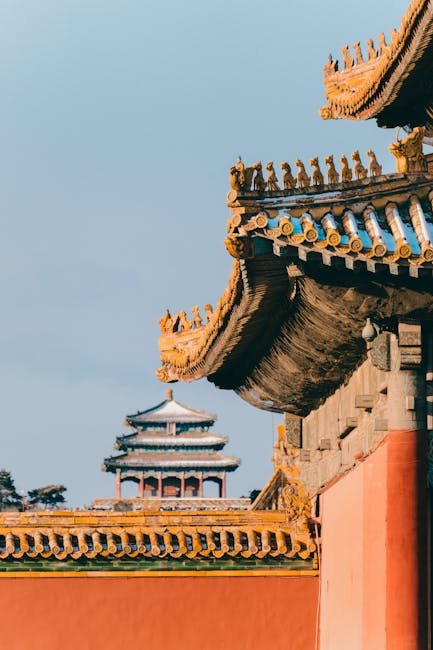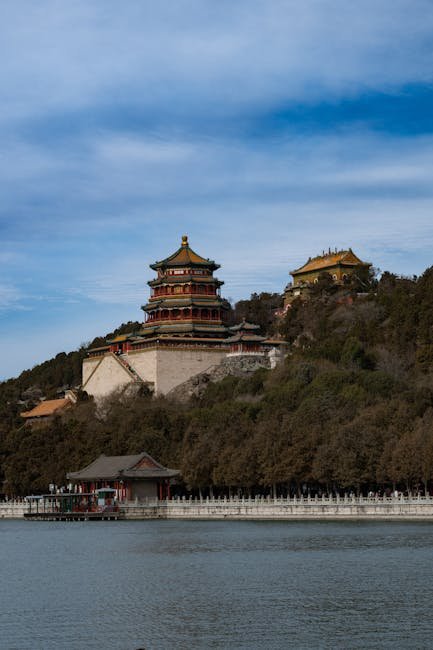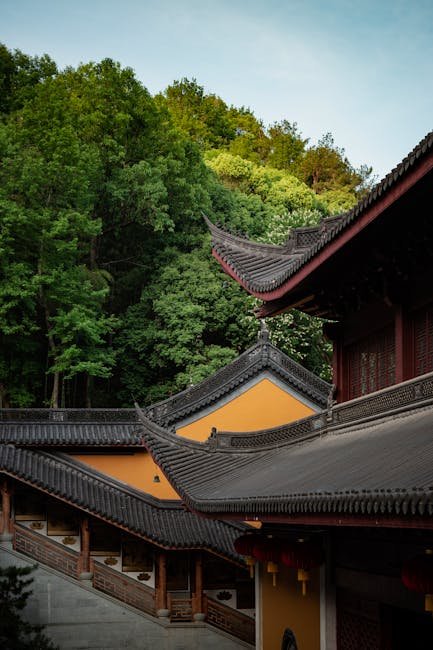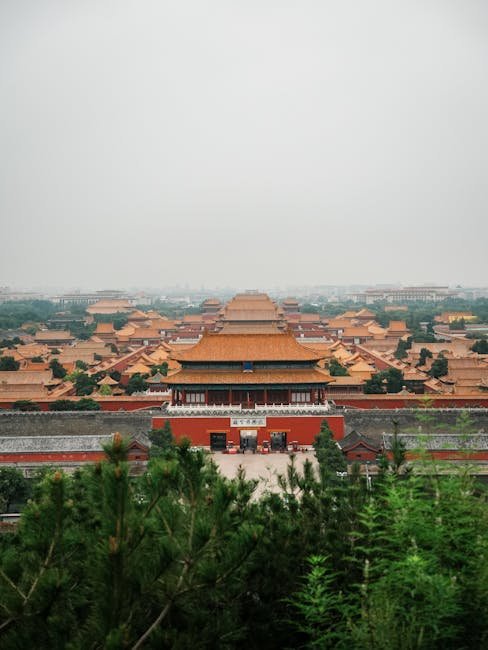
The Forbidden City (故宫, Gu Gong), located at the center of Beijing, is the world's largest and best-preserved imperial palace complex. Built between 1406 and 1420 during the Ming dynasty, the Forbidden City served as the imperial palace for twenty-four emperors of the Ming and Qing dynasties over nearly five centuries. Covering 72 hectares with 980 surviving buildings, the Forbidden City is not merely a palace but a walled city that functioned as the ceremonial and political center of the Chinese empire.
Layout and Design
The Forbidden City is designed according to a master plan that embodies the cosmological principles of imperial China. The complex is organized along a north-south axis, with the most important buildings facing south — the direction of the emperor and of favorable qi. The outer court (外朝, wai chao) to the south contains the three great halls where the emperor conducted state business — the Hall of Supreme Harmony (太和殿, Tai He Dian), the Hall of Central Harmony (中和殿, Zhong He Dian), and the Hall of Preserving Harmony (保和殿, Bao He Dian). The inner court (内廷, nei ting) to the north contains the imperial residences, including the Palace of Heavenly Purity (乾清宫, Qian Qing Gong), where the emperor lived and worked.
The architecture of the Forbidden City follows a strict hierarchy encoded in building form, roof type, color, and decoration. The Hall of Supreme Harmony, the most important building, has a double-eaved hip roof covered with yellow glazed tiles — the highest-ranking roof form in the imperial yellow color. Its throne hall is the largest surviving timber structure in China, measuring 64 meters wide and 37 meters deep. The building's eleven-bay frontage, its nine-bracket dougong, and its eleven roof-ridge figures all signify supreme status within the architectural hierarchy.
"The Forbidden City is the most complete expression of Chinese imperial architecture in existence. Its planning, its buildings, its colors, and its decoration constitute a three-dimensional textbook of Chinese cosmology, social hierarchy, and aesthetic principles. To walk through its gates is to enter a world where every architectural decision was made according to a coherent system of meaning."