Protective walls that shield entrances from evil spirits while creating privacy and architectural drama.
The screen wall (照壁, zhao bi, or 影壁, ying bi) is a distinctive element of traditional Chinese architecture — an independent wall placed just inside or outside the main entrance of a building or compound. Screen walls serve multiple purposes: they provide privacy by blocking direct view into the courtyard from the street; they protect the building from negative energy (sha qi) according to feng shui principles; and they serve as decorative surfaces that announce the status and taste of the household.
Origins and Symbolism
The screen wall tradition dates back to ancient Chinese beliefs about spirits and energy flow. According to traditional Chinese cosmology, evil spirits travel in straight lines and cannot turn corners. By placing a wall directly inside the entrance, the building's inhabitants ensured that any malevolent spirits entering through the gate would be blocked by the wall and unable to proceed into the living quarters. This spiritual protection function was combined with the practical need for privacy in a culture where the entrance gate was often aligned directly with the main hall.
The screen wall also played an important social function. As visitors approached the entrance, the screen wall would block their view of the interior, creating a sense of anticipation and revealing the courtyard only after the visitor had passed through the gateway and turned. This controlled revelation of space is a fundamental principle of Chinese architectural design, creating a sequence of spatial experiences that unfold gradually rather than being revealed all at once.
"The screen wall is a characteristically Chinese solution to the universal problem of threshold spaces. It manages the transition from public to private, creates a moment of pause and orientation, and provides a surface for the display of status and cultural refinement. In a single element, it serves practical, symbolic, and aesthetic functions."
Types and Decoration
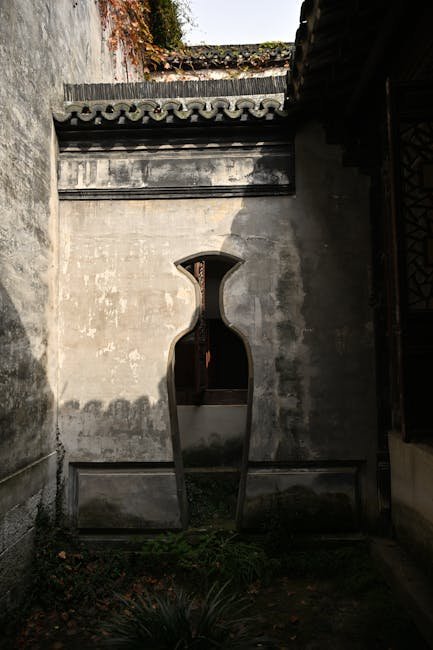
Screen walls come in several types, distinguished by their position relative to the entrance. An "outside screen wall" (外影壁) is placed on the street side of the gate, visible to passersby. An "inside screen wall" (内影壁) is placed just inside the gate, facing the visitor as they enter. The most elaborate screen walls are found in the courtyard houses of wealthy families, where they are constructed of brick or stone and covered with decorative carvings or glazed tiles.
The decoration of screen walls follows established conventions. The central panel typically features a large character for good fortune (福, fu) or longevity (寿, shou), or a carved scene with auspicious symbolism — cranes and pine for longevity, mandarin ducks for marital fidelity, bats for good fortune (the word for bat, 蝠, is a homophone for good fortune, 福). The top of the wall is often capped with a miniature roof, complete with tiles and ridge ornaments, making the screen wall a building in miniature. In imperial architecture, screen walls are sometimes surfaced with yellow or green glazed tiles, their decoration regulated by sumptuary laws.
Contemporary Relevance
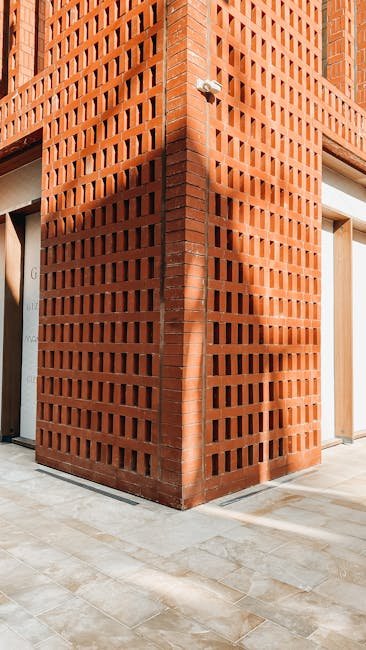
While modern Chinese architecture has largely abandoned the formal screen wall, the principles it embodies remain relevant. Contemporary architects often use freestanding walls, water features, or plantings at building entrances to create privacy, manage views, and provide a transition between public and private space. The screen wall's function of controlling the visual sequence — revealing space gradually rather than all at once — is employed in museums, hotels, and cultural centers that seek to create a sense of journey and discovery.
For homeowners interested in Chinese design, a reinterpreted screen wall can be an effective way to add privacy and architectural interest to a modern home. A well-designed screen wall at the entrance creates a moment of pause, defines the threshold between outside and inside, and provides an opportunity for decorative expression. Whether executed in traditional brick and tile or in contemporary materials such as metal, glass, or stone, the screen wall principle remains a valuable tool in the architect's repertoire.